
Who This Amazon FBA Inspection Page Is For
Amazon FBA orders see the highest uptake rate of third-party inspection services in China among all types of purchase orders. This inspection & guide is written for Amazon private-label sellers, sourcing managers and brand owners importing finished goods from China direct to US FBA. It focuses on the practical, on-site QC distinctions during pre-shipment inspection — what a factory QC stamp actually covers, and what Amazon's receiving system actually enforces.
Most Amazon sellers treat FBA inspection as nothing more than a label check. It is true that incorrect ASIN labels, carton marks or non-compliant packaging can get your stock rejected at Amazon fulfillment centres. But many costly issues emerge even when every label scans perfectly: inconsistent colour, assembly defects, mixed SKUs, packaging degradation and missing accessories. These problems are only uncovered after inventory is received — bringing negative reviews, elevated ODR, removal orders and expensive return freight from China.
The core issue is simple: factory QC and Amazon fulfillment centre receiving operate under two separate acceptance systems. A shipment can pass the factory's internal QC and still fail Amazon's intake process. The product itself may be functional, yet the acceptance criteria the factory follows and the rules Amazon's automated receiving system uses are built for entirely different purposes.
What Changed for US FBA Inbound Rules
For more than a decade, Amazon acted as a safety net for non-compliant shipments. If cargo arrived missing an FNSKU, fitted with an unapproved polybag, or slightly over weight, Amazon could apply corrections for a fee and move the stock into fulfilment. That safety buffer has largely disappeared. As of 2026, Amazon has largely phased out its on-site FBA prep and labeling service for US inbound shipments. Goods must arrive fully compliant; there is no on-site correction lane for most non-compliance issues.
Penalties have hardened alongside this policy shift. Inbound defect fees for non-compliant oversized items have typically ranged from $5.72–$8.25 per unit (published rates are subject to Amazon's periodic updates). For a 500-unit shipment with labeling violations, these extra charges can easily top $300 before the listing goes live. The practical takeaway: catching compliance problems at the factory costs little more than extra label stock and an inspector's time. Discovering them at Amazon's dock means weeks of delay, return freight and a damaged inbound record.
Factory QC vs FBA Receiving: Two Acceptance Logics
Factory QC is built around product conformance to your specification: fit, finish, function and defect limits against your agreed AQL. Its core question is: "Is this product acceptable to sell?"
Amazon receiving is built around automated warehouse operability: scanability, sortability, safety and unit isolation. Its core question is: "Can our robots and staff receive, route and store this without manual intervention and risk?"
This fundamental disconnect explains most receiving surprises. A standard factory QC checklist rarely validates:
- Barcode quiet zone, surface reflection and compatibility with fixed industrial scanners (not phone cameras)
- Carton compression and stacking performance after weeks of high-humidity ocean transit (factories only test static boxes)
- Inner pack configuration matching your locked inbound plan
- Polybag thickness, suffocation warning font size and exact wording requirements
Factory QC is product-centric. FBA receiving is supply-chain-automation-centric.
The FBA Inspection Framework: Two Independent Layers
A "QC passed" stamp from the factory is not a guarantee of successful FBA intake, because the factory's quality system typically focuses only on the product itself. And a dedicated Amazon FBA pre-shipment inspection from professional third-party inspection company normally operates across two independent verification streams: FBA compliance audit and standard AQL product inspection. You select a scope aligned with your risk profile instead of paying for a generic, one-size-fits-all checklist.
Layer 1: FBA Compliance Verification (Warehouse Acceptance Rules)
This stream covers requirements enforced by Amazon's receiving workflow and catches issues that trigger direct rejection or penalty fees:
- ASIN unit labels: placement, glare, no overlay, verified on industrial-grade scanners (not smartphone scan apps)
- Master carton FBA shipment labels: matched against PO, SKU and total quantity
- Label hygiene: no overlapping stickers, leftover old marks or residual adhesive covering barcodes
- Carton integrity: construction, crush resistance, no excessive dampness, holes or tears
- Weight and dimension verification: per carton, to avoid unexpected oversize classification
- SKU segregation: preventing mixed SKUs inside one master carton, a leading cause of split receiving and unexpected split-inbound fees
- Regulatory markings: prohibited items, restricted packaging, polybag suffocation warnings and country-of-origin labelling
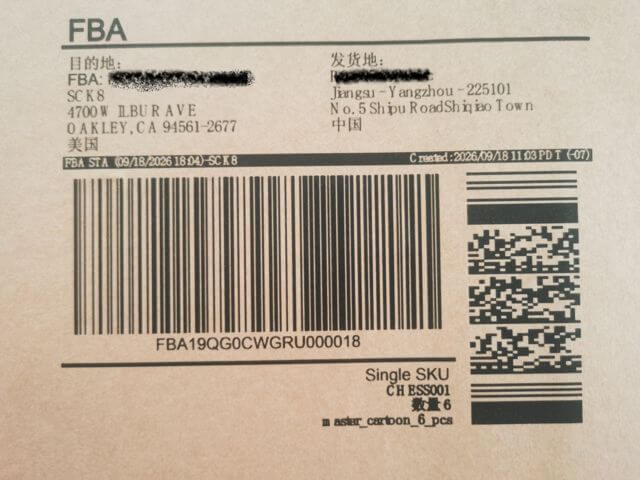
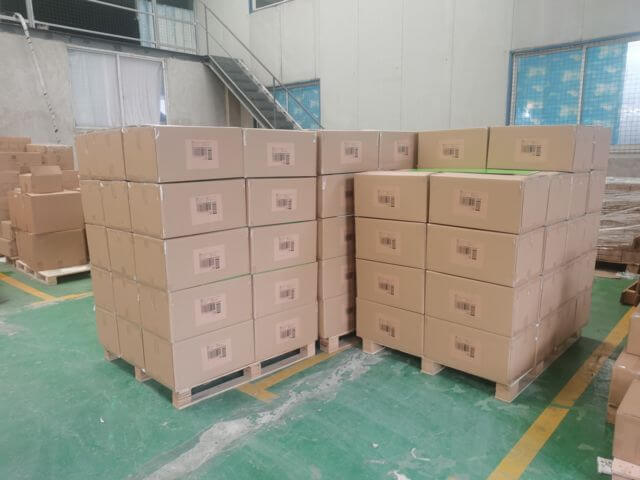
Manufacturer Barcode (UPC/EAN) vs FNSKU
If you use Manufacturer Barcode / Commingled Inventory, the original factory UPC or EAN must be clean, printed on a flat surface and not covered by any overlay sticker. A common failure we observe is factories applying promotional stickers or "Made in China" marks directly across the UPC. Our inspectors confirm the original manufacturer barcode is intact and scannable. When factory UPC quality is unreliable, we advise switching to an Amazon FNSKU that fully covers the original mark, rather than trying to salvage a faulty factory barcode. (Note: Commingled inventory eligibility is restricted by category, hazardous goods rules and child-safety listings.)
Data-Operational Mismatches: Where Clean Labels Still Fail
Amazon's receiving automation reads your inbound plan, but that plan originates from manual data entry on the seller side. Four mismatch patterns account for most "labels scanned fine, shipment still locked" cases we see.
The "Absolute Count" Reconciliation
A very common hidden mismatch occurs when the factory produces 99 cartons instead of the planned 100, or packs 50 units per carton instead of the approved 48. We physically count master cartons and multiply by the confirmed case pack quantity, reconciling this total against the exact figures in your Amazon inbound plan. If you planned 1,000 units but the factory built 1,020, we flag this immediately. Shipping extra units without updating the inbound plan triggers a receiving discrepancy and can lock inventory in a manual audit queue for weeks.
Overflow & Backorder Allocation Risk
Sellers sometimes create an inbound plan for partial shipment, with remaining units marked as backorder to ship later. Factories frequently pack all finished goods together into the first shipment, ignoring the split delivery schedule. When backordered units arrive early in the first container, Amazon receiving flags a quantity mismatch, locks inventory and forces manual plan adjustment. During the quality control inspection, cross-check packed quantity against the release quantity authorised for this sailing — not the total PO quantity. Any units marked for later backorder must be physically segregated and held at the factory, not loaded with the first batch.
Multi-Destination Inbound Split Risk
Many sellers create a single shipment plan and split inventory across multiple Amazon fulfilment centres automatically. Factories often treat the whole PO as one single pool and pack cartons randomly, without segregating cartons by destination sub-plan. When cartons meant for FBA Warehouse A are mixed with cartons allocated to Warehouse B, Amazon's receiving system triggers discrepancies, delays inventory placement, and may lock the entire shipment for manual sorting. During the quality inspection, cross-reference each carton's destination assignment against the split inbound plan. If cartons carry mixed destination allocations without clear physical segregation and marking, we flag this as a critical operational risk before loading.
Inbound Plan Revision Timing Risk
Even when physical packing is 100% correct, late edits to your Seller Central inbound plan create an invisible mismatch. Many sellers adjust case quantities, destination splits or total units after the factory has finished packing and labelling cartons. The carton-level FBA shipment labels are generated from the old plan. Amazon's receiving system cross-references label data against the live inbound plan, not the PDF you sent to the factory. Our inspectors validate that the label data printed on each master carton matches the final, live inbound plan version — not an earlier draft you shared weeks before production. We flag cases where sellers plan to revise the inbound plan after inspection, because label regeneration and re-labelling will be required before shipment.
Decoding Amazon Inbound Defect Codes
When a shipment is rejected or fined, Amazon returns defect codes inside Seller Central. Understanding what each code means on the factory floor is critical to stopping repeat penalties:
- Code FN (FNSKU / Barcode Issue): unreadable barcodes, missing labels or stickers placed over the original UPC. This is our most frequently encountered finding and maps directly to our industrial scanner verification step.
- Code BX (Box / Carton Issue): damaged cartons, missing carton labels, or cartons exceeding the 25 inch or 50 lb limits.
- Code SP (Small Parts / Polybag Issue): missing suffocation warnings, polybags thinner than 1.5 mil, or loose items that should be bagged.
- Code EX (Expiry / Lot Code Issue): invalid expiry formatting, missing dates, or dates printed in the wrong MM/DD/YYYY format.
When our inspectors identify a physical non-compliance, they map the finding to these standard defect codes. This gives your operations team clear visibility of exactly which penalty trigger the factory is creating. (Note: Code names and trigger criteria can be updated by Amazon without notice; this mapping reflects common Seller Central behaviour and is not an official Amazon specification.)
Variation & Parent-Child ASIN Packing Risk
Parent-child variation listings create one of the most overlooked FBA receiving failure modes. Factories will often pack different child ASINs together in the same master carton for packing convenience, even when your inbound plan requires strict segregation. Our inspectors cross-check every SKU against your variation structure and inbound instructions:
- Confirm each child ASIN is packed separately where your inbound plan requires segregation
- Verify FNSKU labels correspond to the correct child ASIN, not only the parent listing
- Flag inner boxes, inserts or printed materials carrying incorrect variant imagery or descriptions
Even when every barcode scans cleanly, mixed-variant cartons cause split receiving, inventory misalignment and listing attribution errors that are extremely difficult to fix after intake.
Brand Authorization & Component Authenticity Risk
FBA receiving does not merely verify carton integrity; it also validates that the product inside is authentic. If your product carries a brand logo, a licensed character, or relies on specific branded components (e.g. YKK zippers, 3M adhesive), the factory's supply chain must be strictly verified. A common failure we catch: the factory runs out of specified branded components and substitutes them with unbranded or cheaper alternatives without telling the buyer. When a customer complains, Amazon triggers an Inauthenticity review and freezes your inventory. During inspection, we verify:
- Logo and trademark consistency: comparing physical logo placement, font, and stitching against your approved brand guidelines
- Component traceability: spot-checking branded hardware or materials to ensure no silent substitution occurred during mass production
- Authenticity markers: confirming the presence and correctness of any anti-counterfeit tags, holographic stickers, or serialized authenticity labels required for your listing
We do not conduct full trademark registration validation or legal IP due diligence; this is visual verification against your approved artwork and component specs only.
Country-of-Origin Marking: The Hidden FBA Compliance Risk
"Made in China" marking is not just a customs requirement; Amazon receiving and US import rules enforce specific placement, legibility and language rules. Common defects we observe: COO print hidden under labels, tiny font unreadable by warehouse staff, markings only on outer cartons but absent from retail units, or incorrect country wording. While this rarely triggers an instant barcode rejection, non-compliant COO marking can draw customs holds, ASIN audits, or listing warnings long after stock is checked into FBA. Our compliance checklist verifies COO marking exists on the correct level — unit, inner box and master carton — as your import broker requires.
A separate common failure: the "Made in China" marking matches import rules, but the HS / tariff code declared on your entry differs from the product construction. This is customs-level risk, not Amazon receiving risk, but it can hold cargo before it reaches fulfilment centres. Our quality inspection does not validate tariff classification, though we flag obvious mismatches between printed product construction and your declared HS description for your broker to review.
California Prop 65 Warning Labels: A Silent Legal Time Bomb
If your product is sold into California, specific chemical warnings are legally required under Proposition 65. Unlike safety standards that are caught at the border, missing Prop 65 labels often go unnoticed by Amazon receiving — until a professional plaintiff or consumer advocate files a lawsuit. Factories frequently fail to add Prop 65 warning labels because they are unfamiliar with US state laws, or they use generic warning labels that do not match the specific chemical hazard of the product (e.g. a blanket "Cancer" warning on a product that only requires a "Reproductive Harm" warning). During FBA compliance inspection, we cross-reference the factory's physical packaging against your authorized chemical test reports:
- Warning presence: ensuring the exact Prop 65 warning label is printed on the retail packaging or inserted as a separate hangtag
- Exact wording: verifying the label explicitly states the specific chemical hazard (e.g. "WARNING: This product can expose you to chemicals including lead, which is known to the State of California to cause cancer")
- Placement: confirming the warning label is clearly visible and not covered by other barcodes or shipping marks
We do not perform chemical laboratory testing; our check only verifies that printed warning text and placement match your valid test report requirements.
Expiry-Dated Inventory Rules
For food, cosmetics, supplements and battery products, Amazon enforces strict expiry date formatting and shelf-life rules. A factory can produce fully functional goods that still fail receiving simply because the date is printed YY/MM instead of the required MM/DD/YYYY, or because the remaining shelf life falls below Amazon's category threshold on arrival. Our expiry inspection adds three checks to the standard compliance workflow:
- Format validation: confirm printed dates match the exact format you declared to Amazon
- Placement check: expiry marks on unit and carton, not covered by tape or labels
- Shelf-life calculation: verify remaining shelf life at the time of inspection, plus the ocean transit window, still meets Amazon's category minimum
Layer 2: AQL Quality Inspection (Product Integrity)
A clean compliance check does not guarantee acceptable product quality. This is the layer most label-only QC providers skip. We sample per your agreed AQL and inspection level (I / II / III, plus special levels S1–S4) following ANSI/ASQ Z1.4 — the full sampling tables and switching rules are on our AQL sampling chart page, and you can compute your exact sample size with the free AQL calculator. We verify:
- Visual consistency: colour matching, finish and cosmetic criteria
- Functional assembly and fit
- Inner pack and unit quantity accuracy
- Completeness of manuals, accessories and warranty inserts
- Packaging integrity: blister packs, gift boxes, shrink wrap and printed inserts
- Printed mark correctness on retail packaging and UPC verification
(Note: Regulated categories including children's goods and storage products often require formal TIC / third-party certification via Amazon TIC direct validation. Visual product inspection at the factory cannot substitute for required lab reports. We can connect you with approved testing labs.)
Lot Definition for Consolidated FBA Shipments
ANSI/ASQ Z1.4 rests on one foundational rule: sampling applies to a homogeneous inspection lot. Many consolidated shipments pool production runs from different dates, factory shifts or sub-suppliers into one container. If you sample this blended group as a single lot, a bad small batch can remain hidden and only surface once Amazon opens cartons. For CFS consolidated cargo, our inspectors separate distinct production runs, suppliers and shift batches into independent lots before sampling. Each lot receives its own AQL sample and pass/on-hold/fail decision. We never combine heterogeneous batches into one sampling group.
Lot Traceability & Serialized Inventory Challenges
Many regulated categories such as medical accessories, power banks and consumer electronics require serialized tracking. Generic AQL sampling only checks quality, but FBA serialized shipments demand unit-level traceability. We verify that serial numbers printed on units, inner boxes and master cartons match your inventory file upload. Common failures include duplicate serials, out-of-sequence labeling, serials printed on removable stickers, or serial ranges unevenly split across cartons. If Amazon's serial capture scan fails at receiving, the entire batch may be locked regardless of product quality. For serialized orders, our product inspection includes spot verification of serial log alignment alongside standard AQL sampling.
Non-Conformance Severity Matrix for FBA Shipments
We grade all findings inside the final report into three bands so your team can prioritise action:
- Critical: non-compliance that triggers automatic rejection, penalty fees or safety holds (unreadable FNSKU, missing suffocation warnings, incorrect Hazmat marking, expired stock). Critical findings place the shipment On-Hold, independent of AQL sample results.
- Major: product or packaging defects that raise review risk, ODR or listing suppression, judged against your agreed AQL limits.
- Minor: cosmetic imperfections that do not threaten FBA intake, safety or listing performance; recorded for supplier feedback only.
This matrix separates compliance failures (binary pass/fail) from quality defects (statistical AQL-based judgement). This distinction is what separates a generic pre-shipment inspection from FBA-specific QC.
Should You Tighten AQL Just Because the Shipment Is for FBA?
No. AQL values (e.g. General Inspection Level II, 2.5 / 4.0) are statistical thresholds for product quality. They do not change purely because the destination is Amazon. What changes is the extra compliance checklist layered on top. Tightening AQL arbitrarily will not fix labeling, carton or inbound-plan mismatches; it only increases sample size, inspection time and cost. The correct workflow is: keep your quality AQL based on your product risk, and run the separate FBA compliance checklist alongside it.
The Hidden Cost of Over-Inspecting vs Under-Inspecting
FBA sellers often swing between two costly extremes:
- Under-inspect: only run a quick label check, skip AQL sampling. Cheap upfront, but high exposure to ODR, removal orders and lost ranking.
- Over-inspect: tighten AQL unnecessarily, increase sample size and inspection days for every FBA shipment regardless of supplier track record. This inflates QC spend without lowering Amazon receiving rejection risk, because AQL does not catch barcode, pallet or inbound-plan compliance issues.
Our risk-based scopes are built to avoid both. For stable, low-defect suppliers with repeat replenishment, Scope 1 compliance-only checks keep your QC overhead low. For new suppliers, redesigned SKUs or high-review-risk categories, Scope 2 adds AQL sampling where quality risk actually exists. Inspection scope should follow the risk, not automatically scale up just because the shipment is routed to FBA.
When You Do Not Need Dedicated FBA Compliance Inspection
FBA compliance checks add cost, and they are not mandatory for every shipment. Dedicated FBA scope is usually unnecessary if you use a trusted, long-running Amazon prep centre in the US, and all labeling, bagging and palletisation work will be completed stateside after cargo arrives. In this scenario, a standard AQL pre-shipment inspection focused only on product quality is often sufficient. Even so, we still recommend a baseline visual check of raw packaging and branding before export, to avoid downstream rework at the prep centre.
How We Validate Scanability (Not Just Phone Scan)
A phone scanner can read many labels that Amazon's fixed industrial scanners reject. Our inspectors use professional laser handheld scanners selected to match the type of hardware deployed at Amazon receiving docks. We test each label against three failure modes:
- Quiet zone: minimum 1/8-inch blank margin around every barcode
- Print density and contrast: avoiding faded ink or glossy surfaces that create reflection
- Overlay and crease check: labels cannot cross box seams, fold lines or tape joints
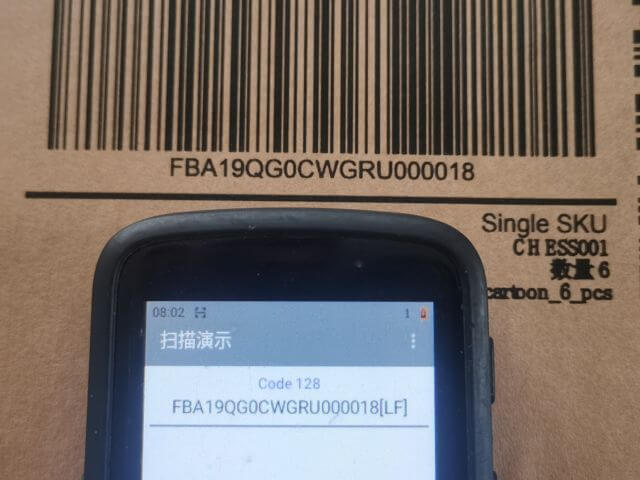
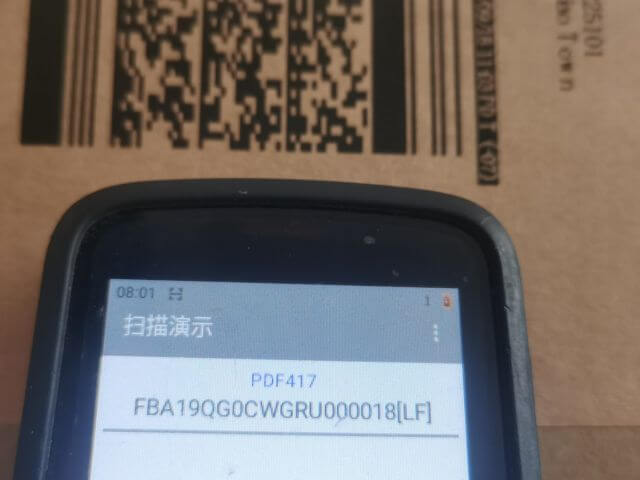
Label Roll and Thermal Print Defects (Phone Scanners Miss These)
Scanability is not only about one sample sticker. Factory thermal label rolls carry batch defects that appear randomly across the whole run: inconsistent ink density, label stock slippage, thermal fading and partial voids in the barcode pattern. We sample labels from multiple positions on the roll: start, middle and end of the production batch. A label that scans correctly at the beginning of the roll may fail later once the printer ribbon wears down. We also check adhesive backing and liner quality. Poor release liner causes labels to shift, curl or peel during packing and transit — a failure that only appears once the pallet reaches Amazon.
The Physical Reality of Corrugated Cartons on Ocean Freight
Factory QC inspects cartons sitting stationary in a dry packing room. Your cartons then spend weeks in a sealed ocean container where humidity can reach 85–90%, softening the corrugated flute. Our carton assessment goes beyond visual damage:
- ECT / Edge Crush Test rating review: confirm the board grade matches the stack weight
- Stacking sequence review: heavy items placed at the bottom of the pallet, not loose on top
- Overhang check: cartons extending more than one inch past the pallet edge will be crushed in transit and rejected by Amazon
Overbox Unit Weight Drift Risk
Sellers often input pre-calculated overbox weight and dimensions into the inbound plan based on prototypes. Mass production packaging variation, extra inserts, foam or protective packing can increase actual carton weight. Even a small per-carton weight drift, multiplied across hundreds of cartons, can push individual master cartons over Amazon's 50 lb limit or push SKUs into a higher weight tier. Our inspectors weigh sampled finished packed cartons — not empty prototypes — to catch this mismatch early, and verify carton dimensions against your declared plan.
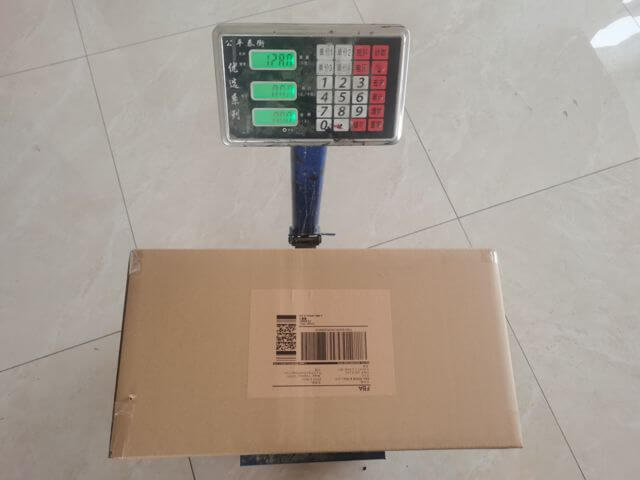
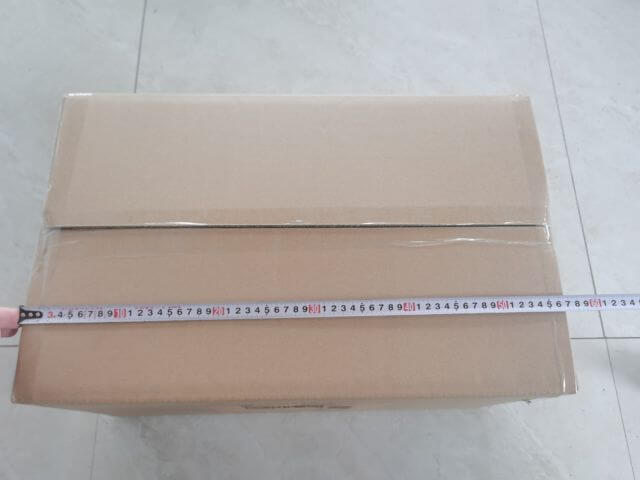
The Bundle and Multi-Pack Trap
Sellers often create multi-packs or bundles (e.g. "Buy 2 Get 1 Free" or kits) to increase average order value. The factory then wraps these units together with shrink film or an outer retail carton. This creates a highly specific set of FBA rejection risks. If the outer shrink wrap tears during transit, the bundle splits, and Amazon will receive the units as individual products, destroying your inventory count. Furthermore, if the FNSKU label is applied to the inner unit instead of the outer bundle, Amazon will scan the inner unit and misclassify the entire bundle. Our product inspection for multi-packs adds specific checks:
- Shrink wrap integrity: verifying the thickness and tightness of the film, ensuring it will not rip or slip off under weight
- Label placement: confirming the FNSKU is placed securely on the outermost packaging, covering the original individual barcodes entirely
- Bundle configuration: ensuring no prohibited items (like liquids or specific electronics) are grouped in a way that violates Amazon's "Ships in Own Container" rules
The Tape and Sealing Trap
Packers often use branded, coloured or extra-wide decorative tape for a neat appearance. Amazon's automated imaging systems rely on consistent contrast. Highly reflective, dark or printed tape can interfere with scanner capture even if Amazon does not formally ban it. Our inspectors prefer clear, low-reflection packaging tape. We also verify H taping: sealed along the centre seam and both flap edges. Boxes sealed only along the top centre split open once humidity weakens the board inside the container.
Temperature-Sensitive Goods: The "Ocean Container Oven" Effect
Factory QC inspects goods at room temperature. However, a steel ocean container sitting on a deck in the tropics can easily exceed 60°C (140°F) during a 30-day transit. For cosmetics, solvent-based adhesives, soft TPU/TPR plastics, and temperature-sensitive food items, this heat exposure can cause irreversible separation, deformation, or label adhesive delamination. Our quality inspection for heat-sensitive products includes a thermal stress screening: we review the MSDS and check the factory's packaging choice (e.g. whether they used heat-resistant liners or sufficient insulation). If a factory packs heat-sensitive goods in standard corrugated boxes without thermal protection, we flag it as a transit risk before the container is loaded.
Pallet Specification for Amazon FBA
Carton compliance is only half the pallet requirement. Non-conforming pallets can be refused by the carrier before they even arrive at the Amazon fulfilment centre. Our pallet verification covers:
- Standard US GMA 48” × 40” pallet footprint
- No double-stacking unless pre-approved by Amazon
- Total height control and no carton overhang beyond 1 inch
- Four-way forklift entry, no broken deck boards or protruding nails
- Stretch wrap containment: tight enough to prevent carton shift in transit
- ISPM 15 heat-treatment stamp for all solid wood pallets exported to the United States
Pallet Label Placement & Barcode Orientation Risk
Even fully compliant GMA pallets will fail receiving if pallet labels are positioned incorrectly. Amazon requires pallet shipment labels on two adjacent sides of the pallet, with barcodes upright, flat, and free of stretch-wrap covering. We commonly find factories tucking pallet labels underneath stretch wrap, placing them only on one side, or rotating barcodes 90 degrees. Fixed scanners at Amazon docks struggle to read sideways or wrapped-over pallet labels. Our pallet check verifies label quantity, placement, orientation and ensures the barcode area remains uncovered by stretch film.
Amazon Partnered Carrier & LTL Appointment Risk
Pallet compliance is separate from Amazon LTL appointment and carrier requirements. Even fully compliant GMA pallets can be turned away at the dock if your shipment lacks a confirmed appointment, pallet labels do not match the carrier manifest, or total pallet count diverges from the appointment submission. Our inspection does not book or validate Amazon LTL appointments, but we reconcile pallet count and pallet-level label data against your carrier manifest before loading, so you catch count mismatches before tendering to the trucking line.
Prep Errors From Third-Party Prep Centres
Many sellers send bulk goods to US-based third-party prep centres to apply labels, bagging and palletisation before sending into FBA. This shifts prep risk overseas, but new failure modes emerge. A prep centre may re-package, re-bag or re-label your inventory without cross-referencing your original inbound plan, ASIN rules or bundle structure. Common issues include misapplied FNSKUs, incorrect polybag warnings, broken bundle integrity and mixed SKUs after repacking. Our China-side inspection cannot eliminate US prep-centre risk entirely, but we add a supporting check for sellers using overseas prep: we document the base packaging, unit markings and bundle construction before cargo leaves China. This creates a baseline record so you can prove whether defects or mislabeling happened at the factory or at the US prep facility.
Unique Risks at CFS Consolidation Warehouses
Inspections at third-party consolidation warehouses carry failure modes you do not see at the manufacturer: inconsistent label stock, leftover stickers from previous shipments, last-minute re-packing by the consolidator and uneven carton grades pooled from multiple suppliers. There is also "neighbour risk": your pallets sit beside other vendors' cargo. If adjacent stacks collapse from weak cartons or poor stretch wrap, your goods can be damaged before the container seals. During CFS inspection we audit palletising, stretch wrap and segregation, and trace each lot back to its original factory.
How to Explain FBA Requirements to Reluctant Factories
Many factories have served Walmart, Target and offline buyers for years and push back on Amazon's unique rules: "This packaging passed for all our other customers." You can share two practical lines with your merchandiser:
For polybags: "Amazon requires 1.5 mil minimum polybags with a legible suffocation warning. If this fails scanning, Amazon may apply per-unit inbound defect fees; published rates are subject to Amazon's periodic updates. Please confirm you can source compliant bags pre-shipment."
For carton sizing: "Any side over 25 inches triggers oversize classification and extra fees. We keep master cartons under 24.5 inches to build margin for manufacturing tolerance."
Factories respond best when you tie requirements to concrete financial penalties, not abstract "Amazon rules."
Case Snapshot
A US home goods brand placed a repeat replenishment order for storage bins. The factory printed every FNSKU label correctly and passed a basic label check. During our full Scope 2 FBA inspection, our AQL sample revealed inconsistent stitching and cracked plastic tabs across roughly 12% of the sampled units. The shipment was placed on hold for sorting and rework before ocean booking. Catching this before departure saved the seller from hundreds of negative reviews, elevated ODR and expensive FBA removal and return freight. This illustrates a core truth for FBA supply chains: perfect label scans do not protect you from product quality defects that damage listing performance after check-in.
Three Service Scopes for FBA Shipments
Not every order requires the same inspection depth. We match the scope to your supplier track record and product risk:
Scope 1 — Light FBA Compliance Check (Labels & Cartons Only)
Best for mature, stable suppliers with low defect history. We skip full AQL product sampling. Focus: FNSKU, carton marks, SKU segregation, dimensions and pallet rules. Ideal for repeat low-risk replenishment runs.
Scope 2 — Full FBA Pre-Shipment Inspection (Compliance + AQL Sampling)
Our most popular package for Amazon brands. We run the complete FBA compliance checklist plus ANSI/ASQ Z1.4 AQL sampling on finished goods. One unified report covers both compliance status and quality findings. Recommended for first orders, new factories, redesigned products and high-review-risk categories including toys, home goods and kitchenware.
Scope 3 — FBA Inspection + Container Loading Check (CLC)
For larger FCL or LCL shipments direct to Amazon. After the product and compliance inspection, our inspector stays through loading to supervise carton sequence, pallet stability, loading segregation, container condition, sealing and photo documentation. This eliminates mix-ups after the factory signs off. See our container loading check service.
Risk Stratification by Amazon Category
FBA inspection risk changes substantially by category, which guides our recommended scope:
- Children's toys & baby goods: dual risk — mandatory safety certification traceability plus strict polybag / choking-parts rules; Scope 2 is almost always required. See our toy inspection scope.
- Home storage & furniture: high carton crush, oversize and pallet risk; packaging and stacking assessment is critical. See our furniture and home goods inspection scope.
- Electronics & battery-powered goods: Hazmat documentation, UN38.3 test reports, packaging and marking compliance, and serial traceability checks; Scope 2 plus extra Hazmat visual screening. See our electrical and electronics inspection scope.
- Low-risk repeat consumables: stable supplier history often qualifies for Scope 1 compliance-only checks.
Our inspectors maintain category-specific checklists that we update as Amazon's listing and receiving rules change.
Electronics & Battery Hazmat Review Trap
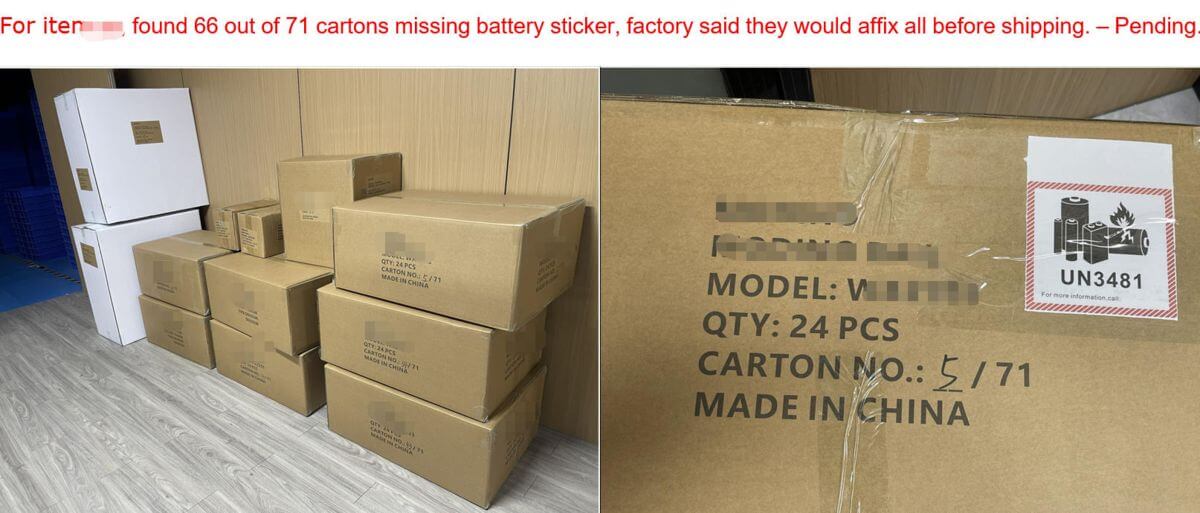
Electrical goods and anything carrying a lithium battery carry a hidden receiving delay risk beyond physical damage. Even if the product works perfectly and labels scan, incorrect packaging marks, incomplete SDS, or battery graphics printed on retail packaging can trigger an Amazon Hazmat review that halts inventory for weeks. Our inspectors review UN38.3 test reports and MSDS documentation, and screen retail packaging for accidental battery graphics, icons or wording that can trigger an erroneous Hazmat classification when the product contains no battery. If your item is non-battery but the artwork looks like a rechargeable product, we flag this before shipment.
The field photo below is a typical finding of this class: battery marks missed on part of a bulk run — caught only because every carton face was walked, not just the first row.
Special Packaging Programs: FFP and SIOC
If your listing is enrolled in Amazon's Frustration-Free Packaging (FFP) or Ships in Own Container (SIOC) programme, a standard checklist is insufficient. SIOC packaging must pass the ISTA-6 Amazon over-boxing test as part of APASS certification.
Overbox Conflict for SIOC / FFP Certified Packaging
A frequent hidden failure for SIOC/FFP listings is unauthorized secondary overboxing. Once a product is certified as Ships in Own Container, the factory or consolidator must not add an extra outer shipping carton without re-testing and re-certifying the packaging. Factories often add overboxes casually to prevent scratches during ocean transit. This single change voids the APASS certification, triggers receiving exceptions, and can remove the SIOC badge from your listing. Our inspectors confirm whether the shipment matches your declared packaging mode: SIOC, FFP, or standard overboxed. If overboxes are present on a SIOC-certified SKU, we flag it as a critical compliance risk.
Common Expensive FBA Pitfalls Sellers Miss
- Labels scan on a phone but fail Amazon fixed dock scanners (gloss, quiet zone, thermal print defects)
- Correct ASIN labels paired with the wrong physical product, only discovered after receiving
- Cartons look fine at packing, but soften and crush inside the container
- Random mixed SKUs in shared master cartons causing split receiving
- Quality defects ignored because the order only included a label check
- Missing or non-compliant polybag suffocation warnings
Our FBA Inspection Workflow
- You send the packing list, PO, ASIN table, inbound plan PDF, label specs and your agreed AQL limits.
- We assign an inspector local to your factory or CFS warehouse in China.
- On-site work: FBA compliance audit, barcode scanner verification, AQL product sampling, pallet and carton review.
- Real-time photos and preliminary findings shared during inspection.
- Final report issued: independent compliance result + AQL quality decision, photos and corrective recommendations.
- If critical non-compliance is found, shipment is marked On-Hold, and you decide: rework, re-label, sort or delay shipment.
What the FBA Inspection Report Covers — and What It Does Not
Our final report has two independent result blocks: Compliance Result and Quality Result. Each non-conformity includes photos, location, quantity and pass/hold/fail status. Compliance issues are binary and can trigger Amazon penalties regardless of sample size. Quality defects are evaluated against your ANSI/ASQ Z1.4 AQL sampling plan.
Clear exclusions:
- We cannot run destructive lab testing on-site
- We cannot verify internal sealed components you cannot open for sampling
- We cannot validate that your Seller Central inbound plan itself was configured correctly
- We cannot guarantee Amazon will accept the shipment, as Amazon can update rules or make discretionary receiving decisions after our inspection
Our checks align with Amazon's public US inbound specifications, though Amazon's automated workflows and receiving teams retain discretionary authority. Even fully compliant shipments can be held due to backend listing problems, ASIN restrictions or factors outside physical packaging.
Our quality inspection team supports Amazon importers across China manufacturing hubs. Inspectors complete recurring training covering inbound policy changes, FNSKU scan failure modes, pallet standards, TIC documentation and Hazmat visual screening. Our checklists are maintained internally and updated continuously, not copied from generic public QC guides.