
On-Site Story: The Friday Rescheduling Call and the Validation of "Real" Inspection
For this China inspection service, it was commissioned by a European offline retail furniture brand. But before our inspector even stepped foot inside the factory, the assignment kicked off with a classic supply chain drama.
Originally scheduled for a Saturday inspection, the factory suddenly called our office on Friday afternoon. "Are your inspectors working on Saturday?" they asked cautiously. "If not, we can easily push it to Monday — let the inspector enjoy the weekend…"
Our team explained the inspector was already locked in and everything was ready. Yet the factory persisted, nudging us to postpone. Sensing something amiss, our scheduling coordinator cut straight to the point: "Are the goods actually not fully finished? If so, we can reschedule this for you without applying the standard late-notice penalty." (By standard protocol, cancellations or postponements require a 3-day advance notice to avoid a $100 late-notification fee.)
Hearing that, the factory let out a massive sigh of relief: "Yes! The goods are still being packed, and they definitely won't be finished tomorrow."
Our coordinator promptly updated the technical team and rearranged the calendar, reminding the factory to communicate schedule changes earlier next time. In reality, that $100 fee isn't about collecting penalties — it's about training suppliers to respect timelines and protect the buyer's delivery schedule. Late surprises cause immense pressure on downstream supply chain operations.
With the schedule sorted, our inspector arrived at the facility on Monday morning. The factory staff immediately praised our company's flexibility, contrasting it with rigid third-party inspection agencies that slap fines over minor infractions. They enthusiastically guaranteed the delay was entirely worth it: "Every single component has been checked on the packaging line. Absolute perfection. You'll see for yourself — a flawless batch!" Our inspector smiled. When quality is good, the buyer reorders, the factory earns repeat business, and everyone wins.
The Turning Point: When "Big Agencies" Miss the Mark
The inspection began smoothly. Inbound counts and carton samplings all checked out. But then came the critical testing phase: drop testing and structural assembly. That's when the defect surfaced.
The factory staff were utterly stunned. The packaging supervisor was rushed over to the inspection table. Taking one look, the supervisor defensively protested:
"Unless a client specifically requests otherwise, we've always packed our KD furniture this way! Other third-party agencies have always passed us without a word. No one has ever raised this issue. Who are you guys anyway — some massive international bureau? The exact same product was inspected by a big-name international QC firm just last month, and they never found anything wrong!"
Our inspector offered a quiet, wry smile and replied: "We can't claim to be a massive international giant. Our company's philosophy is simply to focus on practical, down-to-earth, on-the-ground execution as a mid-sized China inspection company."
For a split second, the inspector felt a tiny touch of self-doubt — wondering if being a "mid-sized team" meant missing some grand industry consensus. But the factory supervisor's immediate response completely turned the tables:
"In my opinion, your level of execution is way more impressive than all those big international bureaus combined!" the supervisor exclaimed. "Especially you, young man — spotting this issue is genuinely impressive. It looks simple now that it's pointed out, but we've been packing this way for years. Countless third-party inspectors have come and gone through our doors, and not a single one ever noticed. For this batch, I personally guarantee 100% full rework. Not just empty lip service like what we give some inspectors when we want them off our backs — I give you my word, this entire batch is getting fixed."
What was the hidden flaw? Unsecured metal hardware.
Product Inspection Finding
This critical packaging and transit defect was found during our pre-shipment inspection of KD furniture destined for a European retail chain.
| Finding Analysis | Details |
|---|---|
| Product | Furniture (knocked-down furniture) |
| Defect | Cracked panels — caused by loose hardware impacting wooden panels during transit simulation |
| Root Cause | Metal hardware (screws, brackets, connectors) was loosely placed alongside wooden panels inside the carton without a dedicated fixed compartment. During transit simulation, the hardware shifted and repeatedly impacted the finished panels, causing dents and cracks. |
| Corrective Action | Secure all metal accessories in a padded compartment, blister pack, or tightly bound inner box to prevent any contact with the finished wooden panels during transport. |
| Frequency | ⭐⭐⭐☆☆ |
| Rework Difficulty | ⭐⭐⭐☆☆ |
| Rework Collateral Risk | ⭐⭐⭐☆☆ |
On-Site Evidence Gallery
The photos below document the real condition of the carton and panel damage caused by loose hardware:
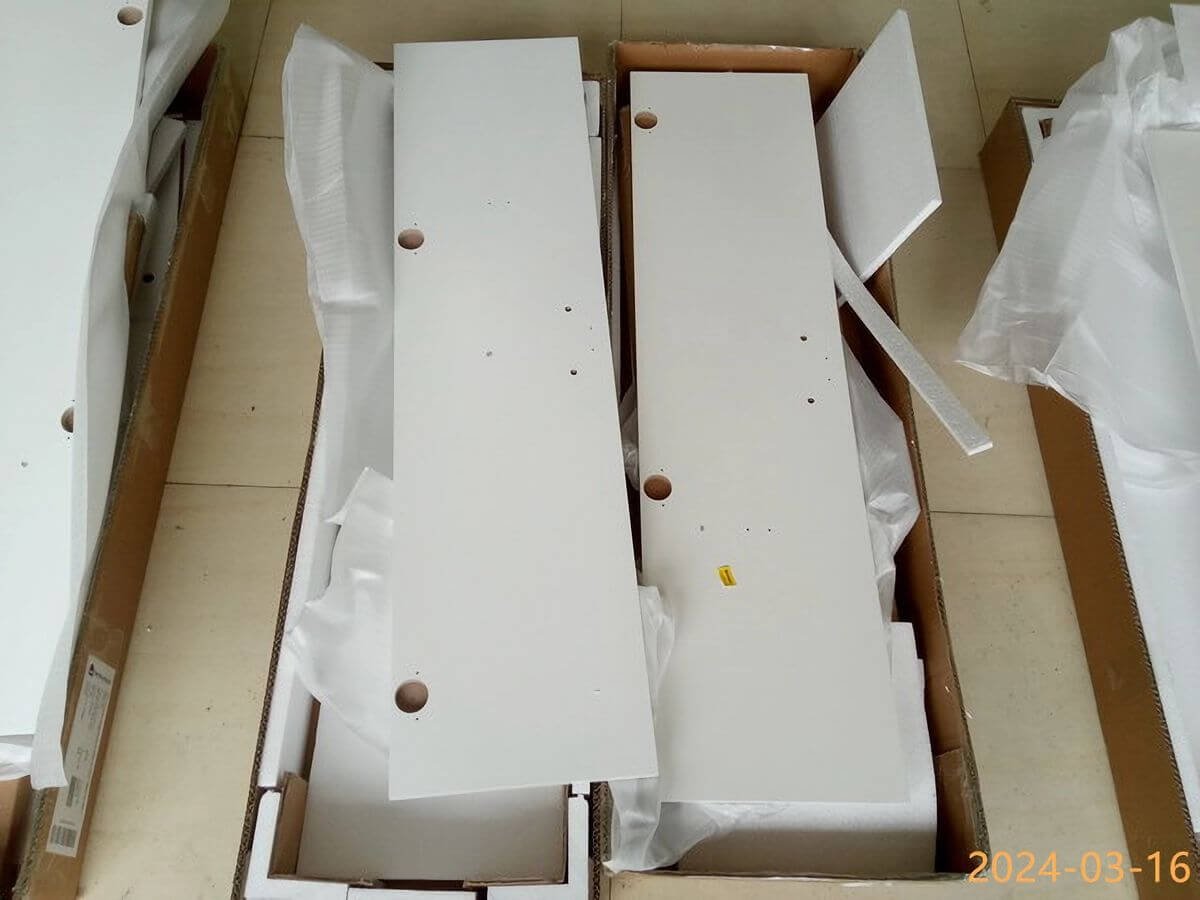
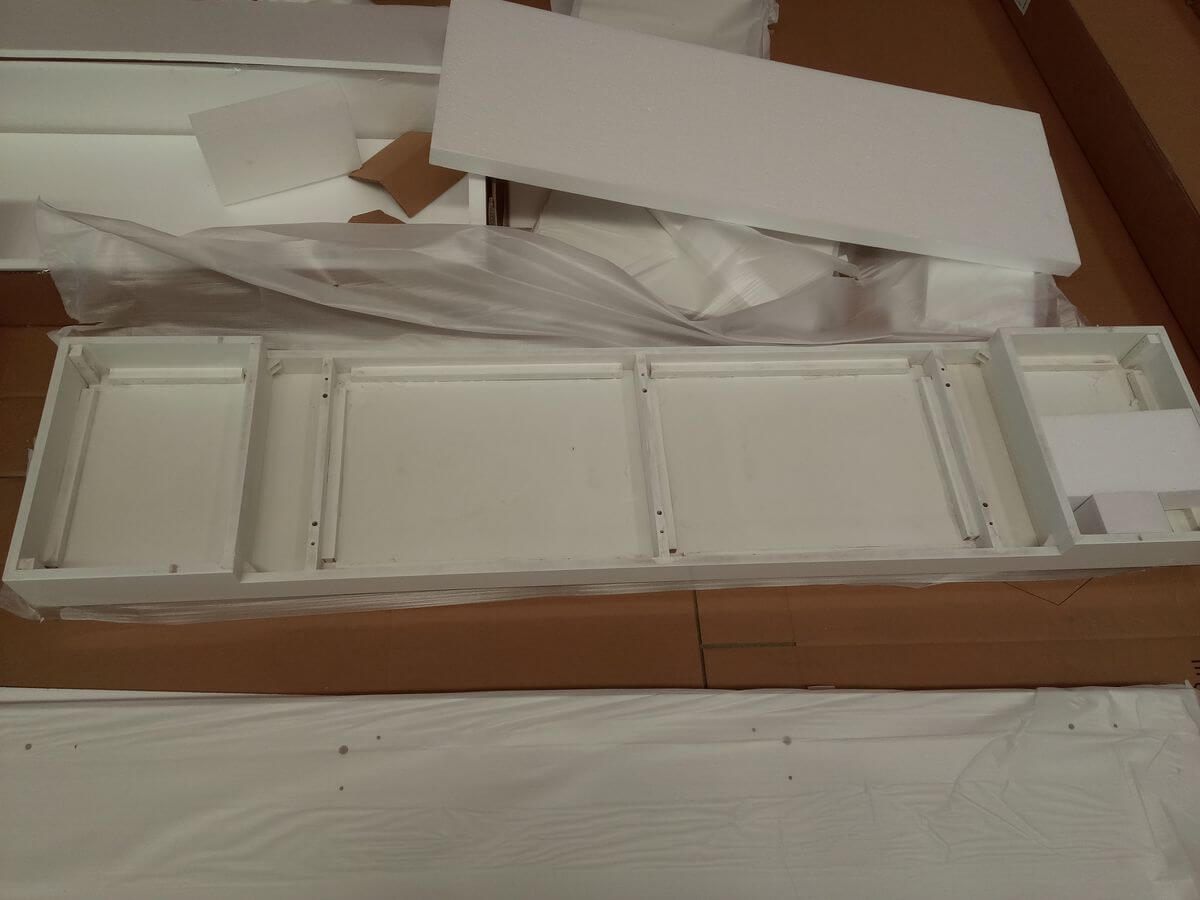
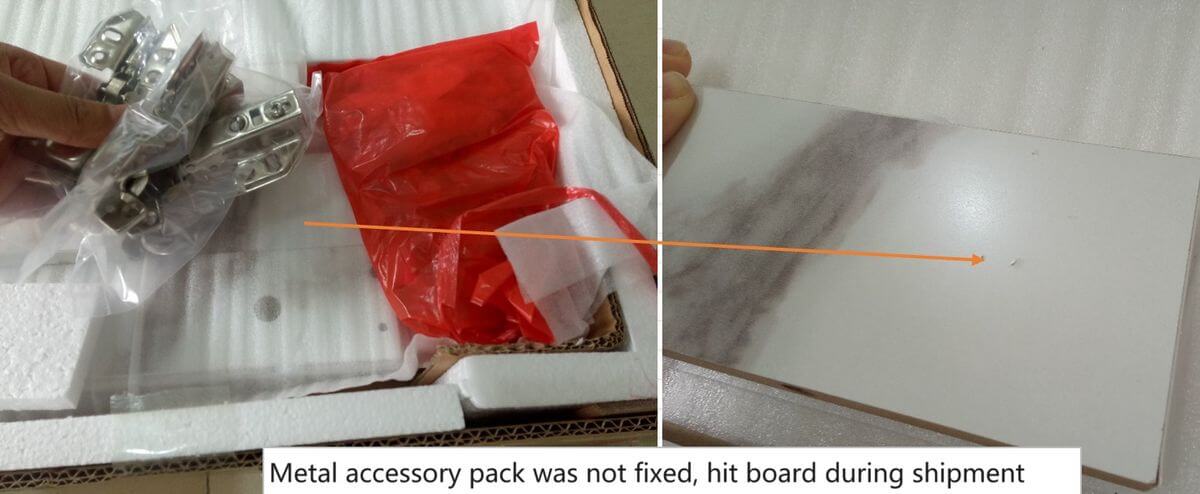
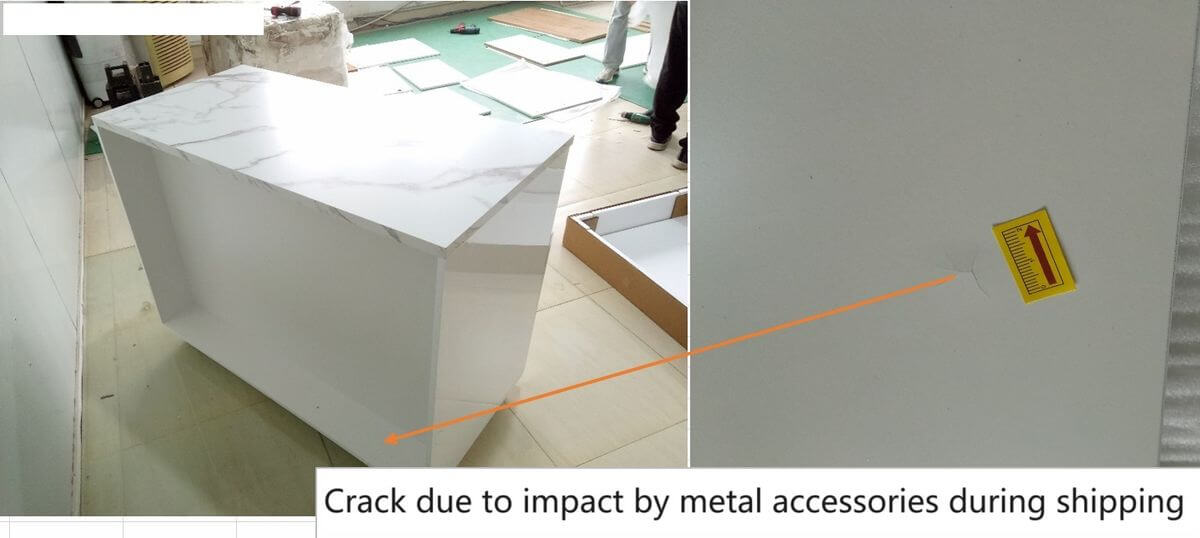
Rework Effort & Risk Assessment
| Evaluation Metric | Rating | What It Means |
|---|---|---|
| Frequency | ⭐⭐⭐☆☆ | Moderate. Frequently overlooked when factories focus solely on outer carton appearance while ignoring internal kinetic damage from heavy metal parts. |
| Rework Difficulty | ⭐⭐⭐☆☆ | Moderate. Requires opening cartons, unpacking panels, separating and securing hardware, and replacing damaged boards. |
| Rework Collateral Risk | ⭐⭐⭐☆☆ | Moderate. Handling heavy furniture panels repeatedly during repackaging carries a risk of secondary corner crushing or surface scuffs. |
💡 QC Insight for Furniture Buyers
When sourcing Knocked-Down (KD) furniture, hardware packaging is a silent killer:
- Metal is heavier than wood finish. If screws, metal brackets, or heavy connectors are thrown loosely into a carton with painted or laminated wooden boards, normal shipping vibrations turn those metal parts into wrecking balls.
- "Other agencies passed it" is a red flag, not a badge of honor. Just because a previous inspector didn't catch a flaw doesn't mean it's right. Big-name global bureaus often rely on rigid, superficial checklist-ticking rather than practical drop-testing and assembly verification.
- Insist on hardware containment. Always require suppliers to bubble-wrap, blister-pack, or box up all metal fittings securely so they cannot make direct contact with finished wooden panels.
- Drop testing is not optional for KD furniture. Panels have no structural support during transit — any hardware movement directly damages them. The cost of one drop test is negligible compared to one batch of customer returns.
For buyers sourcing KD furniture that must survive international shipping, packaging verification is as critical as the product quality inspection itself. A perfect piece of furniture that arrives cracked is a failed product — and a direct threat to your retail brand.
Let CNQ Help You Pretect Furniture Shipment
At CNQ, we don't just check boxes to satisfy a generic template. Our inspection team focuses on real, hands-on physical testing — simulating what actually happens when your cargo faces the rough reality of international transit.
Before your furniture ships, our team ensures:
- Rigorous drop and vibration testing to expose hidden packaging flaws
- Meticulous checks on hardware isolation and internal cushioning
- Assembly verification — not just inspecting parts, but physically assembling the entire unit to test fit, finish, and structural integrity
- Honest, direct reporting that keeps your factory accountable — earning the respect of suppliers through true technical competence
Want to quickly estimate your inspection cost? Use our Inspection Cost Calculator to see how many man-days a single PSI requires.
Frequently Asked Questions About KD Furniture Inspection
Because the goods were still being packed and would not be finished in time. Calling on Friday afternoon, the factory hoped to postpone the Saturday inspection — a classic sign that production was not actually ready for QC.
The inspection found loose pre-installed hardware that cracked the panels of the knock-down (KD) furniture — when hardware is not fixed properly, panels crack during assembly, turning a packaged product into a defective one.
A last-minute reschedule request often means the goods are not ready or something is being hidden. Insisting on the schedule, or granting a reschedule transparently, lets the inspector see the true production status and protects the buyer's delivery plan.
Disclaimer: This case study is based on an actual pre-shipment inspection performed by China Quality Service. Product details and factory information have been anonymized to protect client confidentiality. The technical analysis and recommendations provided are for educational purposes only and should not replace professional on-site evaluation tailored to your specific product and packaging requirements.