
Fashion Accessories Inspection On-Site: A Beautiful Remake — and the Clasp Nobody Checked
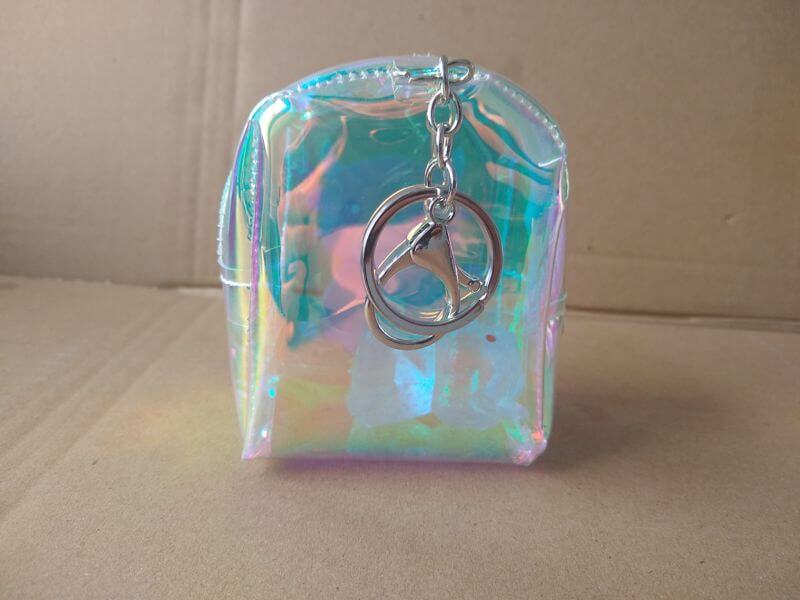
This final randomAQL inspection was commissioned by a UK jewellery and fashion-accessory importer, carried out on 8 July 2023 at an accessories factory in Dongguan, Guangdong. The product is a holographic mini backpack-style keychain coin pouch.
As recalled by our inspector Wilson, the story began three days before the scheduled inspection did. The visit was originally scheduled for 3 July. When Wilson phoned the factory on 2 July to confirm the arrangement, the factory asked to postpone to 8 July. Their explanation sounded reasonable: the previous batch’s laser holographic finish had not come out well, they were remaking the entire order — and, they added, the customer had already been informed and had approved the change.
When Wilson reported this back to our office, our planning team did what it always does with schedule changes: it followed up directly with the buyer. The customer, it turned out, had only learned about the reschedule that same day. Further investigation revealed what had actually happened — the factory had simply forgotten to notify both the buyer and our company about the remake and the new date. Faced with the mistake, and not wanting to incur a last-minute cancellation fee, they tried to present the delay as a customer-approved adjustment.
Situations like this do happen in third-party inspections, and our policy draws a deliberate line between two very different behaviours. For an honest oversight — a genuine production change communicated too late — we do not actually charge a rescheduling fee. A symbolic administrative fee is applied only when a factory knowingly gives us an impossible completion date just to please the customer, and then reschedules at the last minute — the kind of behaviour that genuinely wastes our resources. The purpose of that fee is not revenue. It is a signal: every link in the supply chain deserves honest, realistic dates, so that the buyer and we can plan properly.
For this order, we waived any charges and simply rescheduled the factory inspection to 8 July.
Wilson was greeted at the factory by Linda, the sales contact for this account — polite, warm, and full of praise. She complimented China Quality Service for being more flexible and human-centred than some other inspection companies she had dealt with. This buyer, she explained, was a long-established UK offline retail importer with more than 40 years of history and a solid reputation in the trade. The factory had worked with them for 15 years, and orders had grown steadily year after year. If their quality were inconsistent, or if they were less than honest, the partnership would have ended long ago — let alone grown.
She then told Wilson the story behind this batch — and it was, on its face, a quality-culture story worth praising. The original batch’s laser holographic finish was not actually defective; the heat-press temperature had simply run a little high, washing the holographic effect out slightly — a faint pale tint. The production team said it was fine. Linda looked at it herself and judged it acceptable, then took it to her manager. His verdict, in her telling: the batch is fine — but this customer is a loyal, long-term client, and we owe them good, not merely problem-free. “No problem” is not the same as “good.” So the entire batch was remade, with overtime scheduled to protect the buyer’s retail launch window.
The rush remake was arranged directly by her manager, Linda admitted — and in the shuffle, she lost track of the delivery schedule follow-up, which is how the notification to the buyer and to our company slipped through. The shipment ended up 5 days behind the original timeline. The buyer, when asked, said the delay was no problem — as long as quality stayed consistent.
Linda assured Wilson the remade batch was beautiful. Stitching, edge binding and loose-thread control had all been strictly enforced even through the overtime rush, she said — “you’ll see when you inspect it.” She even kept one sample clipped to her own bag, and thought it looked great. Wilson, listening, was genuinely pleased — good quality makes for an inspector’s pleasant, comfortable day. He began drawing cartons for the sample.
He never got to relax. He opened the first carton and spotted the problem at first glance. A second carton — the same. A third — again. Linda, watching, was stunned: she stood there open-mouthed, unable to speak for a long moment. Finally she found the words: “We poured all our energy into the laser holographic layer. Even after remaking the batch, we kept telling the workers — sew carefully, watch the loose threads. It never once crossed our minds to check the hardware attached to the accessory.”
Finding Analysis — 197 of 315 Clasps That Never Close
One glance at one clasp, and the whole “beautiful remake” narrative collapsed. Here is the finding as it was logged:
| Finding Analysis | Details |
|---|---|
| Product | Holographic mini backpack-style keychain / coin pouch (fashion accessory) |
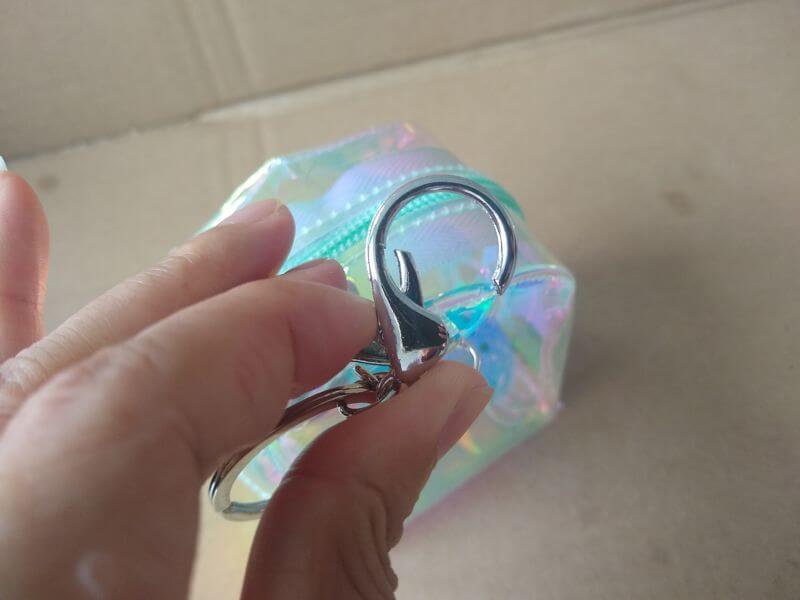
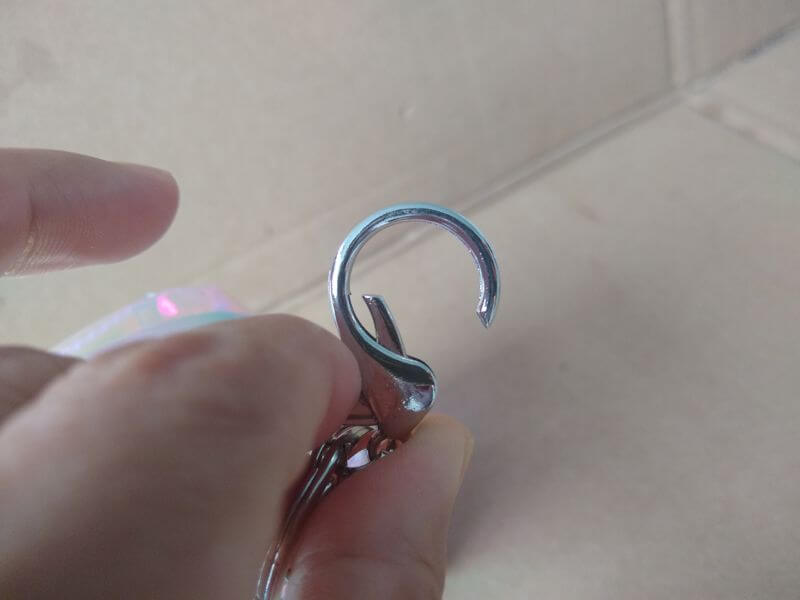
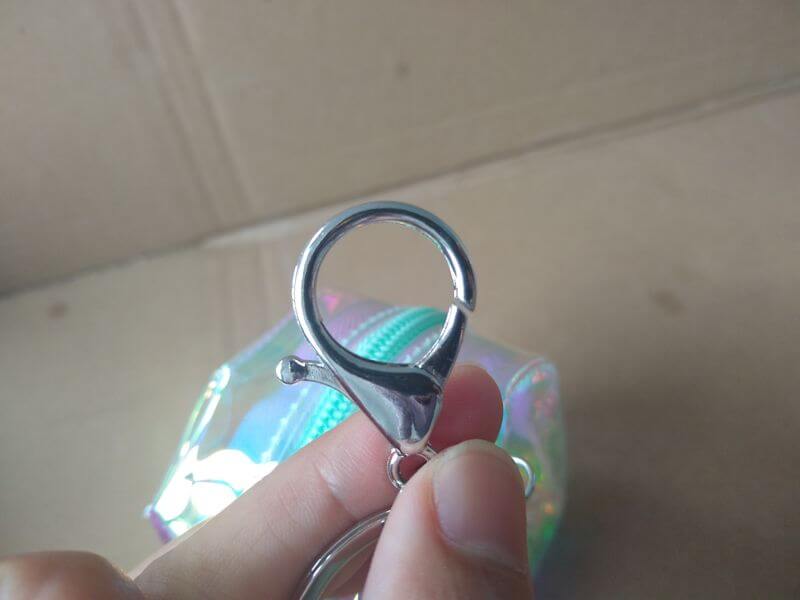
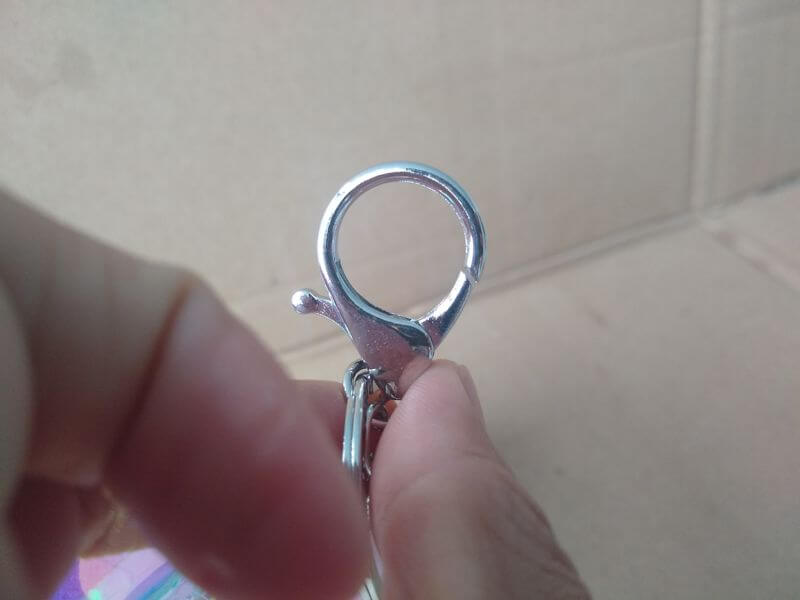
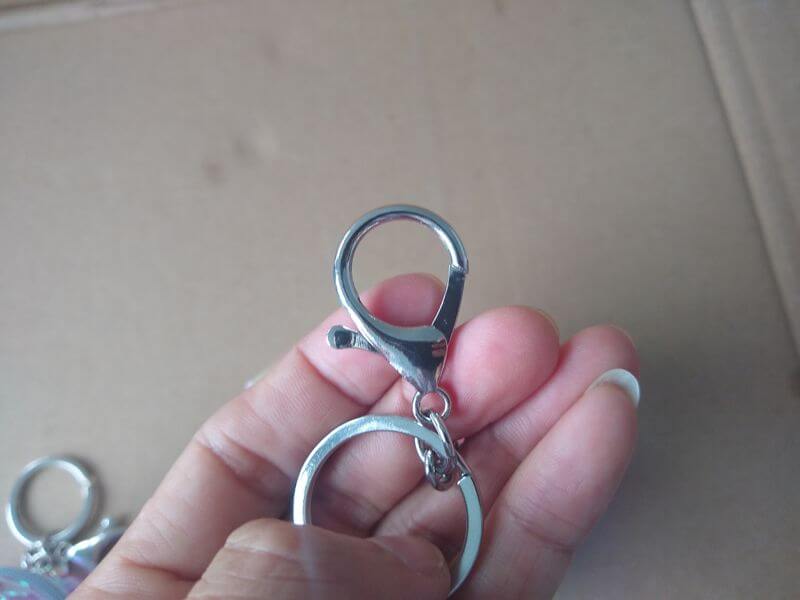
| Defect | The lobster clasp (trigger snap hook) does not fully close, leaving a persistent gap. The keyring can easily separate from the clasp. |
| Root Cause | The spring-loaded gate fails to engage the catch. Potential causes: incorrect stamping dimensions of the hook mouth, a weak or fatigued internal spring, or incorrect gate curvature. The factory’s incoming hardware QC was completely skipped. |
| Corrective Action | 1. Replace all defective lobster clasps — the fault cannot be reliably repaired on finished goods; 2. Implement a 100% functional close test on incoming hardware before assembly; 3. Add a mandatory “hardware function test” item to the final QC checklist. |
| Frequency | ⭐⭐⭐☆☆ — 62.5% defect rate within this specific lot (197/315). Uncommon industry-wide, but this batch was a complete failure on this item. |
| Rework Difficulty | ⭐⭐☆☆☆ — the hardware itself is easy to swap, but doing it for 197 finished pouches is time-consuming. |
| Rework Collateral Risk | ⭐⭐⭐☆☆ — medium: swapping clasps on finished pouches risks scratching the holographic PVC film or damaging adjacent stitching, even with careful handling. |
Defect Classification: Why This Is Major, Not Critical
Under the ANSI/ASQ Z1.4 framework (with buyer contract AQL levels — for consumer fashion accessories typically Critical 0 / Major 2.5 / Minor 4.0), this finding was classified as a Major functional defect, at a defect rate far beyond any acceptable limit. See our AQL Sampling Inspection Guide and the AQL Chart & Sampling Tables for how the sampling and classification work.
Our defect classification follows hazard immediacy and function, not component category:
- Critical — an imminent, immediate safety hazard occurring during normal or foreseeable use, capable of causing injury, fire or electric shock before any intervention is possible.
- Major — a design or functional gap that creates latent risk under foreseeable use, or a defect that would trigger a high customer complaint or return rate.
- Minor — a cosmetic or documentation deviation with no functional or safety consequence.
Why it sits at Major: the product’s primary purpose is to securely hold keys or charms. With a persistent gap in the clasp, a consumer swinging their bag while walking can have the metal ring slip through it — keys fall off and are lost. It is a complete failure of the product’s basic retention function, and it would generate immediate returns and negative reviews. However, it does not pose a direct physical safety hazard — no choking, fire or shock risk — which is precisely why it sits at Major rather than Critical.
Inspection Photos — A Flawless Pouch, a Clasp That Fails
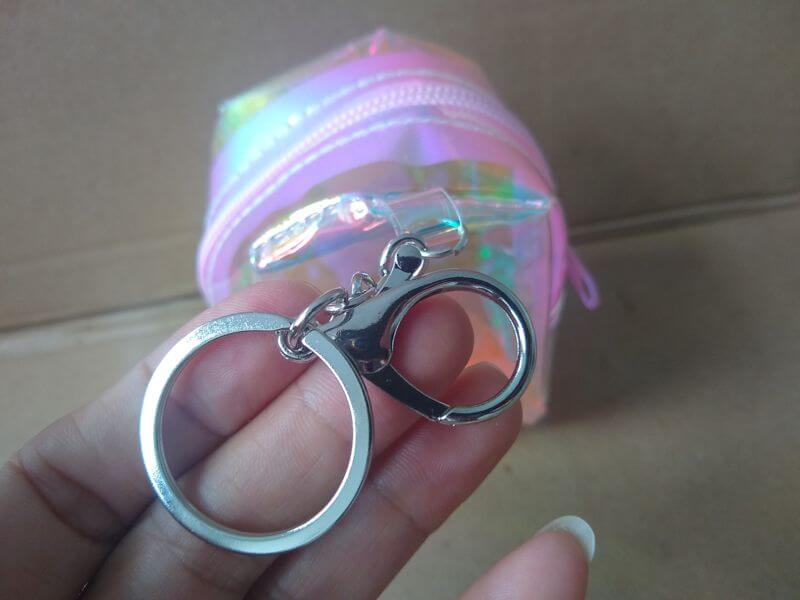
The following photos were taken on-site during this fashion accessories inspection — first the product and a healthy reference clasp, then the defective units, then the repeated open/close test sequence. The contrast is the story: same batch, same test, two different outcomes.
Product Overview & Reference Clasp
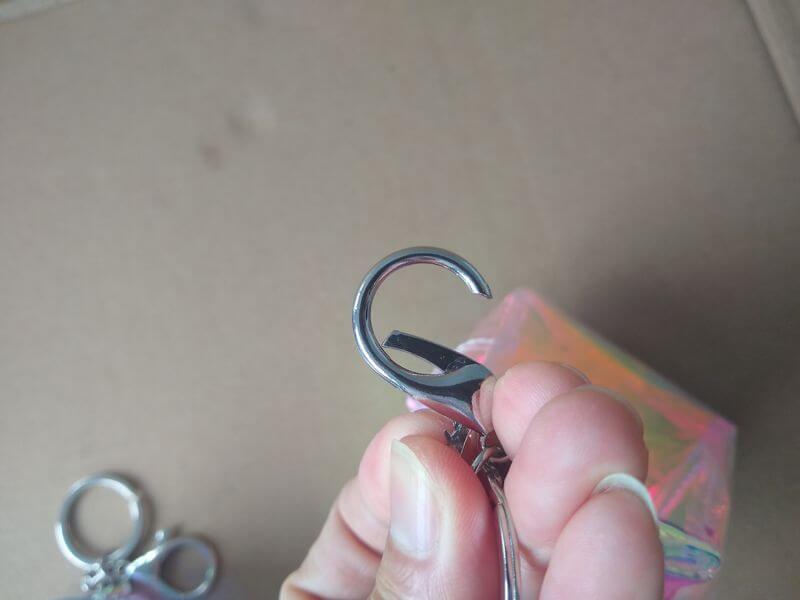
The Defective Clasps
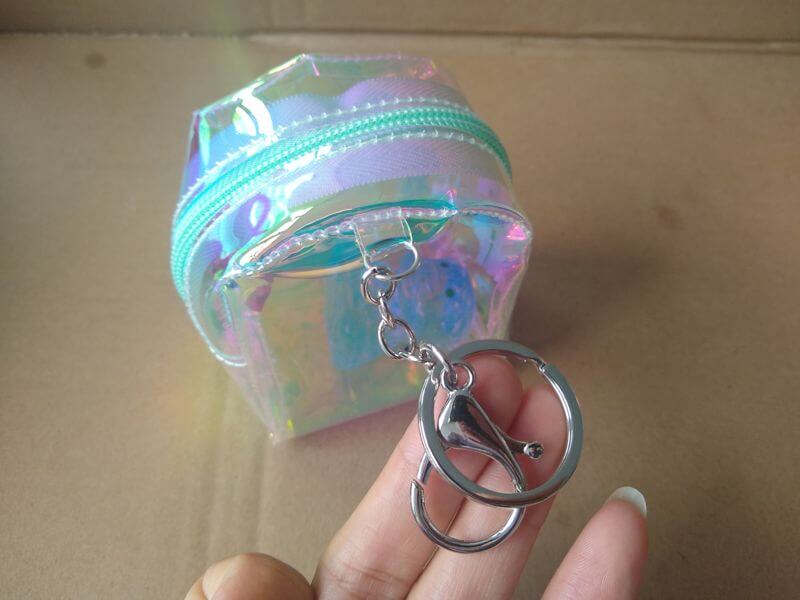
After Repeated Open/Close Testing
Technical Deep Dive — The “Component of a Component” Blind Spot
Total sample: 315 pcs. Defectives: 197 pcs. Defect rate: ≈ 62.5%.
For a lobster clasp, the pass criterion is simple: the spring-loaded gate must close fully with no visible gap after release. A persistent gap means the gate never engages the catch — and under light vibration, jostling or a pull, the clasp can separate from the key ring. On a keychain, that is the product’s entire job.
Why did 197 out of 315 pieces fail? Because the factory was hyper-focused on the primary product — the holographic laser finish and the stitching — and never once looked at the secondary component attached to it:
- The spring mechanism: a lobster clasp relies on a tiny internal spring. If the spring is weak, fatigued or incorrectly installed, the gate will never close flush.
- The assembly error: if the clasp is slightly bent during attachment, the gate alignment goes off — creating a permanent gap.
- The QC blind spot: factory QC teams are trained to inspect fabric, printing and sewing. Hardware is assumed to be “bought-in and therefore perfect.” Nobody sat down and manually opened and closed 315 clasps to verify spring tension.
Why the Factory’s Own QC Never Caught It
When a factory rushes to fix one known quality issue — here, the faded holographic finish — it hyper-focuses on that single corrected item and overlooks unrelated sub-components. That is exactly what Linda admitted on the floor: every check, every reminder to every worker, was about the laser layer and the sewing. The factory’s quality checklist was siloed; it contained no functional close test for the lobster clasps. And the uncomfortable lesson for buyers is this: even when a factory voluntarily re-produces goods to improve quality for a loyal customer, that does not automatically eliminate new or overlooked defects. Third-party inspection exists precisely to cross-check every component and function independently — not only the parts the factory prioritised.
Approved-Sample Bias: Sample-OK Does Not Guarantee Mass-Production Hardware Quality
Many buyers assume that if the pre-production approved sample passes all hardware function tests, mass-produced goods will automatically inherit the same hardware performance. For bought-in metal hardware such as lobster clasps, this is a widespread and risky assumption.
Hardware subcontractors often produce small-batch pre-production samples with carefully selected premium springs and well-maintained stamping dies. Once the mass order starts, they may switch to lower-grade spring wire, worn stamping moulds or adjusted plating parameters to hit the target cost — and this change can happen without your factory or you ever being informed.
In this keychain case we do not know whether the pre-production sample carried good-quality clasps or not. But the risk itself is real and belongs in your QC strategy: passing sample verification cannot replace hardware IQC and on-site function testing during mass production or PSI.
Hardware Manufacturing: Why Lobster Clasps Fail at the Source
A lobster clasp is not a single cast piece; it is a micro-assembly of stamped metal parts, a torsion spring and a pivot pin. At the hardware supplier level, failures usually originate from three specific tolerances:
- Stamping die wear: as the stamping die ages, the hook mouth (the catch point) deforms slightly. A fraction of a millimetre too wide, and the gate can never lock.
- Spring fatigue: low-grade spring wire loses tension quickly, so the gate “bounces” open instead of snapping shut.
- Plating thickness: over-plating the metal for extra shine adds thickness at the gate, preventing it from seating flush into the catch.
The lesson for buyers: you cannot visually inspect a lobster clasp and know it works. The only reliable verification is a physical open/close functional test on the production line, plus a spring endurance test on the incoming hardware batch.
The Hardware Cost Trap
When factories are asked why the hardware was never tested, the unspoken answer is usually cost. As an illustrative example: a high-tension spring hook might cost around $0.15 per piece, while a low-grade zinc-alloy hook with a weak spring costs around $0.03. On a 5,000-piece order, switching hardware “saves” the factory roughly $600 — while a 20% return rate and the brand damage that follows can cost the buyer thousands of times more.
Buyer takeaway: if your product relies on a functional mechanical component — clasp, zipper, buckle — specify the hardware grade in your BOM (Bill of Materials). If the factory substitutes it without telling you, that is a material non-conformity.
When to Test Bought-in Hardware: IQC vs In-Process vs Final Inspection
Many importers assume hardware suppliers ship fully compliant, tested components. Hardware batch failures are extremely common, especially for low-cost decorative accessories. There are three control points, and they are not equal:
- Incoming hardware QC (IQC): catch spring, stamping and plating issues before assembly. The most cost-effective control point.
- In-process check (IPC): verify clasp function after the hardware is mounted, before the full batch is sewn and packed.
- Final pre-shipment inspection (PSI): the last independent check — but rework cost and collateral risk are highest at this stage.
This case demonstrates the classic timing trap: once the hardware is assembled onto finished holographic pouches, rework becomes risky and slow. For high-volume accessory orders, lock in IQC sampling rules for metal hardware before production starts — or schedule a During Production Inspection (DPI) so defective hardware is caught while replacement clasps can still arrive in time.
The same blind spot is not unique to keychain pouches. Hardware-on-hardware failures show up regularly across the accessories family: bag charms, lanyards, luggage tag straps, coin purses, zip pulls and children’s bag pendants — any product whose value depends on a small bought-in metal or plastic mechanism. For soft goods with functional hardware, see our apparel & softlines quality inspection scope: hardware function tests belong in the checklist alongside the stitching checks.
Buyer’s Negotiation Leverage: When the Factory Blames the Client
One more lesson from this case, and it comes from the reschedule, not the defect. The factory initially tried to shift responsibility for the postponement onto the client — claiming a buyer-approved change that the buyer knew nothing about. When a factory does this, it is a serious red flag. Here is how buyers can protect themselves:
- Document everything in writing. Require the factory to confirm any schedule change by email or WeChat message. Verbal agreements are worthless in a dispute.
- Cross-verify with your QC team. Never take the factory’s word that “the client agreed.” A good inspection partner will independently verify the timeline with you — as our planning team did in this case.
- Leverage the inspection report. When a factory rushes a remake to cover a schedule slip, defects like this clasp failure are almost guaranteed. An independent report gives you hard evidence: the factory cannot argue with a 62.5% defect rate.
Real-World Negotiation: Factory Pushbacks and Evidence-Based Responses
When a report shows a 62.5% defect rate, hardware findings rarely go unchallenged. Across our inspection cases, three pushbacks come up again and again when functional hardware defects surface. Here is how buyers can respond with evidence:
- Factory: “The gap is tiny — keys won’t fall out under normal use.” Normal use for a bag charm includes swinging, bumping and the weight of the keys pulling downward. A visible gap means the spring gate never engages the catch — under light vibration or a pull, the ring slips out. The product is not selling “maybe it holds”; retention is its entire function.
- Factory: “We can just squeeze the gate closed with pliers.” A manual squeeze is not a fix. The internal spring is still fatigued or misaligned, and the gap will return once the clasp is used. The hardware must be replaced, not reshaped.
- Factory: “We already spent all our time redoing the laser finish — there is no time to swap the clasps.” Acknowledge the effort, then hold the line: the product is unusable without a functioning clasp. A hardware-swap delay is acceptable; a shipment of defective units is not.
What This Case Teaches About Factory Audit Expectations
Even if you have completed a factory audit (Swift, Standard or Comprehensive) for an accessories supplier, an audit cannot fully eliminate bought-in-component hardware risks.
A factory-level audit evaluates the supplier’s overall quality-management system, documentation and workshop conditions. But most accessory factories outsource metal clasps, snaps and springs to external hardware sub-suppliers — and the audit scope usually cannot dive into every tier-2 hardware subcontractor’s die wear, spring material and plating process.
That explains why a supplier can pass a comprehensive factory audit yet still receive defective incoming hardware batches. Treat the audit as one risk-reduction step, not a complete guarantee for every incoming component: IQC, DPI and final pre-shipment inspection remain essential layers of protection.
Market-Access Expectations for UK-Bound Accessories
Even low-cost fashion accessories sold into the UK and EU fall under general consumer-protection obligations: the product design must reasonably anticipate foreseeable use and function.
- Fitness for purpose: under UK and EU consumer-protection law, a product must be fit for its intended purpose. A keychain that cannot hold keys fails that basic requirement.
- REACH / nickel release: if the lobster clasp touches skin frequently, it must comply with nickel-release limits; a defective plating process can lead to rust or skin irritation. See our EU compliance guide for China exporters for the wider framework.
- GPSR: for EU-bound goods, the General Product Safety Regulation demands that products function safely under normal and foreseeable conditions.
- UKCA and due-diligence records: decorative keychains are low-risk goods, but UK market enforcement still expects manufacturers to verify hardware function. If consumer complaints about clasps opening and losing items accumulate, retailers may face market-surveillance requests to demonstrate supplier control and test records. An independent PSI report can serve as documentary evidence of due diligence.
How to Write Hardware Test Specs (For Your Tech Pack)
Do not just tell your supplier “the clasp must work.” Put quantitative metrics in your tech pack:
- Spring tension: the gate must not open under a 2 N (approx. 200 g) lateral pull.
- Cycle life: the clasp must remain functional after 1,000 continuous open/close cycles.
- Salt spray test: for metal hardware, a 24-hour salt-spray test (per ASTM B117) ensures the spring will not rust prematurely in humid climates.
- Closure definition: specify that the snap hook must close flush without a gap (e.g., <0.5 mm gap tolerance) — otherwise “closed” is open to interpretation.
QC Insight for Importing Buyers & Brand Owners
- The “component of a component” trap: when you focus on the fabric, the stitching and the laser effect, it is easy to forget that the keychain is made of metal. Always add hardware functionality tests — clasp tension, zipper smoothness, swivel rotation — to your quality inspection checklist.
- Function over cosmetics: a beautiful pouch with a broken clasp is 100% scrap. Buyers routinely over-specify cosmetic details while completely ignoring structural hardware.
- The cost of rework: 197 of 315 pieces required rework — a massive bottleneck right before shipment. Caught earlier, during in-process or DPI, the factory could have ordered replacement clasps weeks in advance.
- Schedule honesty is a quality signal: the same factory that hides a reschedule is the one that hides a defect. Our rescheduling policy rewards honest communication — genuine oversight, no fee; a knowingly false timeline, a symbolic admin fee — because realistic dates are what let every party plan and inspect properly.
Preventative Action Checklist for Accessories & Hardware
- ✅ 100% hardware function test: physically open and close the lobster clasp, zipper or buckle on every sampled unit to verify tension and alignment
- ✅ Hardware incoming inspection: before assembly, check a sample of hardware components for spring tension, smooth edges and plating quality
- ✅ Define “closure” in your spec: the snap hook must close flush without a gap (e.g., <0.5 mm tolerance)
- ✅ Schedule an IPC or DPI: catch hardware issues before the entire batch is sewn and packed together
- ✅ Verify the factory’s testing protocol: ask how they test hardware. No documented protocol is a red flag
- ✅ Lock IQC rules for metal hardware: agree in the PO which hardware batches are sampled before assembly, and who holds the rejected ones
How to Check Hardware Yourself (When a Full PSI Doesn’t Fit the Budget)
If your order is small — a 500-piece trial run, for example — a full third-party inspection may not fit the budget. You can still perform a basic hardware spot-check yourself. Just do not rely on the factory’s self-inspection as your evidence.
Here is the 3-step on-site (or live video call) test:
- Step 1 — Random carton pull. Do not accept samples the factory brings to the office meeting room. Walk to the warehouse and pull 3 cartons yourself — from the bottom of the stack, not the ones staged by the door.
- Step 2 — The light-pull test. Open the clasp, let it snap shut, and look at the gap. Then gently try to pull the gate open without pressing the trigger. If it opens under light tension, the spring has no real holding power — treat it as a red flag for the whole hardware batch.
- Step 3 — The 10-cycle quick screen. Open and close the clasp 10 times in a row. If the gate starts to loosen, stick or fail to seat flush within 10 cycles, the hardware will not survive ordinary consumer use. This is a quick screen, not the verdict — the real acceptance criterion is the cycle-life spec (e.g., 1,000 open/close cycles) you put in your tech pack.
If you are doing this over a live video call, ask the factory to keep the camera zoomed in on the clasp — no panning away, no pre-arranged “demo units.”
Keep one boundary in mind: a handful of units you check yourself is a sanity test, not a statistical verdict. Spot-checking cannot tell you the defect rate of the lot the way an AQL-based sample can. When the order value justifies it, a pre-shipment inspection replaces guesswork with a statistically valid pass/fail decision.
Frequently Asked Questions About Accessory Inspection
Is a lobster clasp gap considered a major defect for keychain accessories?
Yes. For keychains and bag charms, retention ability is the core function. A clasp that cannot stay closed is classified as a major functional non-conformity — in this case 197 of 315 sampled units failed the close test.
Can a factory rework a lobster clasp gap defect?
Usually it cannot be reliably fixed on assembled goods without side effects. The failure originates in the hardware itself — the spring or the stamped gate. The practical route is replacing every defective clasp on the whole batch, accepting the added handling risk to the finished holographic film.
Why did the factory QC miss the defective clasps?
Factory QC focuses on what they manufacture in-house — fabric, laser printing, stitching. The lobster clasp is a bought-in component. It was assumed to be perfect and never function-tested. The situation worsened here because the factory had just re-produced the entire batch to improve the holographic finish, and every attention went to that one corrected item.
What should the buyer do if the inspection fails on clasp defects?
Reject the shipment. Instruct the factory to replace all defective clasps with a functioning batch, then schedule a re-inspection to verify the new hardware before releasing the final payment.
We passed pre-production sample testing for the lobster clasps. Can we skip the hardware function test during mass-production inspection?
No. Pre-production sample hardware performance does not guarantee mass-production hardware quality. Hardware subcontractors may downgrade spring material, use worn stamping dies or change plating settings for large-batch production without notification. Sample approval is only one gate — incoming hardware QC and on-site functional open/close testing on mass-produced units are still required.
Disclaimer: This case study is based on an actual pre-shipment inspection performed by China Quality Service. Client-identifying details and factory-specific information have been fully anonymized to protect commercial confidentiality. Technical analysis and QC recommendations are for educational reference only and cannot replace tailored professional product evaluation for your specific project.
Curious what the full report behind such findings looks like? See our annotated sample inspection report — or download complete sample reports from our library.